Search
University of Cambridge Department of Engineering
Structures Research Group
Engineering Department > Structures Group > People


  0

Dr Janet Lees - Sustainable concrete

Selected Projects

Recycled materials in concrete
• MgO cements


Recycled materials in concrete
With an increasing focus on sustainability, there is a growing interest in the use of recycled materials in concrete. Work by others in this area has included investigations of the performance of chopped fibre reinforced concrete containing recycled wood fibres, carpet fibres, tyre cords or even chicken feathers [1]. The aim of current research has been to isolate a selection of recycled polymer materials that could potentially be used as short fibre reinforcement for concrete. Particular considerations are the durability of the materials in concrete and the expected behaviour under flexural loading conditions. This work represented a first step in the ultimate goal of identifying possible low-cost sustainable means of enhancing the tensile capacity of concrete with the addition of waste materials. The use of recycled materials to improve other performance characteristics e.g. thermal properties, fire resistance, of concrete products is also being considered.

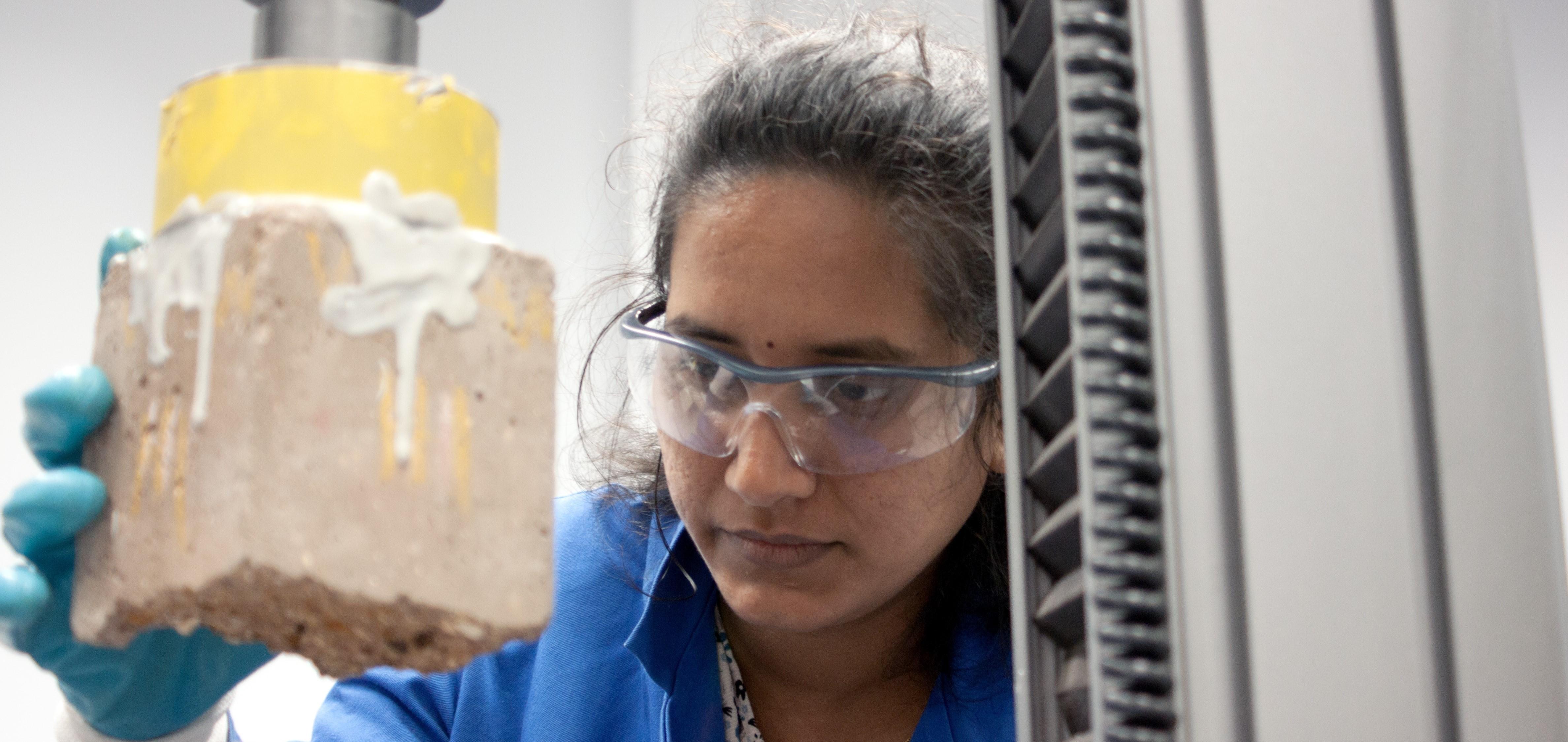
Testing of concrete slab with recycled fibre reinforcement

[1] Wang Y.; Wu G.C. and Li V.C., Concrete Reinforced with Recycled Fibers, Journal of Materials in Civil Engineering, Nov. 2000.


MgO cements
In the manufacture of conventional Portland cement, the constituent materials are heated to very high temperatures (1400C) and, as a result, this process generates undesirable CO2 emissions. From an environmental perspective there are felt to be a number of advantages in the use of MgO cements including, the cements are processed at much lower temperautures thereby potentially reducing CO2 emissions and the materials appear to have a higher propensity for binding with waste materials. However, MgO cements are fundamentally different to Portland cements and thus research is required to characterise the materials and to identify formulations suitable for the inclusion of large volumes of waste. This work is being carried out in collaboration with Dr Abir Al-Tabbaa and Dr Bill Clegg.

Micrograph of eco cement consisting of 90% of PFA. The binder composition has been designed as (MgO0.8 PC0.2) [2].

[2] Liska M., Waste minimisation through sustainable concrete products, First year report, University of Cambridge, 2005 (not available externally)